
The UAE Carry
Published: April 2026 · Desert Gate Capital Research Desk · Dubai, UAE
7-minute read · MENA Venture · UAE · Capital Concentration
“In the first quarter of 2026, every two dollars of MENA venture capital that moved, one landed in the United Arab Emirates. Not in the region. In one country.“
That is not a trend. That is a concentration event. And for founders deciding where to incorporate, where to raise, and where to build the next five years of their company, it is the single most important signal in the regional capital stack right now.
The Data Reality
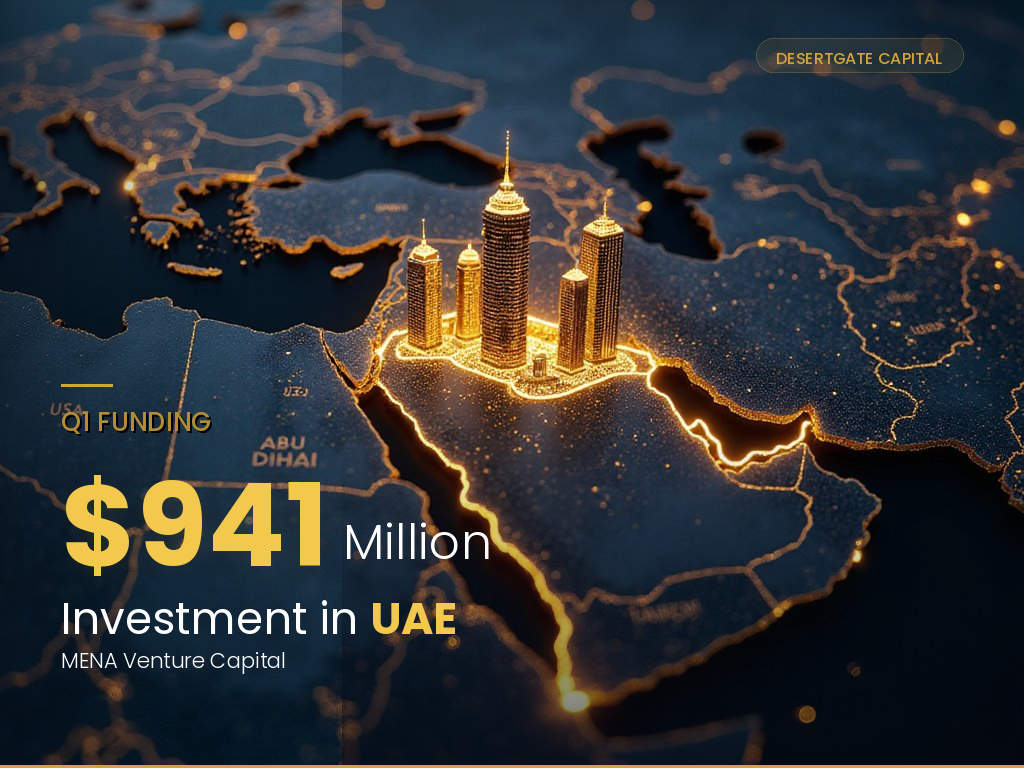
MENA startup funding fell to $941 million in Q1 2026, a 21.5% decline from the prior quarter and a 37% drop year-on-year, according to Wamda’s quarterly regional tracking. The quarter’s monthly cadence tells the deeper story: roughly $500 million deployed in January across 59 deals, $326.6 million in February, and a catastrophic March in which 17 startups raised less than $50 million combined, one of the weakest funding months on record for the region.
Beneath that headline decline, the distribution of what did close is more revealing than the total.
Q1 2026 MENA Funding — Where Capital Actually Went
| Country | Capital Raised (Q1 2026) | Deals | Avg Deal Size |
| UAE | $625.8M | 46 | ~$13.6M |
| Saudi Arabia | $156.7M | 57 | ~$2.75M |
| Egypt | $86.0M | 12 | ~$7.2M |
| Rest of MENA | ~$72.5M | — | — |
| Total MENA | $941.0M | — | — |
Source: Wamda Q1 2026 MENA Funding Report, April 2026.
The UAE pulled $625.8 million across 46 deals. Saudi Arabia, often discussed as the region’s dominant capital story on the strength of its sovereign programs, raised $156.7 million across 57 deals. Egypt landed a distant third at $86 million.
The punchline is not that the UAE raised more. It is that the average UAE deal was roughly $13.6 million, while the average Saudi deal was about $2.75 million. UAE deals were five times larger. The capital is not just concentrated by geography. It is concentrated by round size, suggesting later-stage, institutional, cross-border money finding its way almost exclusively to one jurisdiction.
The Thesis: This Is a Jurisdictional Event, Not a Market Event
A 37% year-on-year decline in regional funding during a period of record 2025 totals ($7.5 billion per Wamda’s annual report) would normally read as a broad-based retreat. It is not. It is a reallocation.
Four structural forces are driving capital into a single jurisdiction while the rest of the region compresses:
- Geopolitical risk repricing. Escalating US–Israel–Iran tensions and disruptions to seaborne logistics through the Strait of Hormuz have pushed institutional allocators to reassess regional risk on a country-by-country basis. The UAE’s neutral diplomatic posture and logistics redundancy have made it the default ‘safe haven’ trade within MENA.
- Fund domicile gravity. DIFC and ADGM are now the two most actively used common-law financial centres in the emerging-market belt. Fund managers deploying into regional portfolios increasingly domicile the fund itself in the UAE, which means regional deal flow routes through UAE-domiciled holding companies even when the operating business sits elsewhere.
- Late-stage capital availability. The size-of-deal gap between the UAE and Saudi Arabia in Q1 2026 reflects the depth of later-stage capital in the UAE — family offices, sovereign co-investors, and international growth funds with on-the-ground UAE teams. Saudi remains deal-heavy but check-size-light at this point in the cycle.
- Cross-border operating neutrality. Founders domiciled in the UAE can hold contracts, IP, and banking relationships that function cleanly across the GCC, North Africa, and South Asia. In 2026’s capital environment, that operational reach is being priced in as a valuation premium.
The Institutional Lens
Professional allocators do not look at the Q1 2026 data as a regional slowdown. They look at it as evidence that the MENA venture map has resolved into a clear hub-and-spoke structure with the UAE as the hub.
The 59-deal January with $500 million deployed is not inconsistent with the March collapse of 17 deals and $50 million. Both prints are consistent with a single model: when conditions are favourable, deal volume follows; when conditions tighten, capital compresses toward the single jurisdiction that allocators trust to function under stress. In Q1 2026, that jurisdiction is the UAE.
This is the same pattern institutional investors observe in any emerging-market capital cycle. India’s GIFT City is running a version of the same playbook. Singapore ran it for Southeast Asia for two decades. The UAE is in the consolidation phase of that arc. Founders who treat it as optional are misreading where the capital and the infrastructure have already gone.
A Framework for Founders: The UAE Domicile Decision in 2026
Desert Gate Capital’s research desk uses the following five-stage framework when evaluating where founders across the region should domicile their holding company and capital-raising vehicle. Most of the framework applies regardless of where the operating business actually sits.
Stage 1 — Capital Source Mapping
Identify where the next 24 months of capital is most likely to come from: regional family offices, GCC sovereigns, international growth funds, or strategic corporates. If more than 50% of the addressable capital sits in UAE-domiciled vehicles — and in 2026 it almost always does — the domicile question is effectively decided by gravity alone.
Stage 2 — Regulatory Fit
DIFC and ADGM offer common-law frameworks, English-language contracts, and investor-familiar fund structures (Investment Companies, QIFs, VCC-equivalent vehicles in ADGM). Compare this to the operating jurisdiction’s local framework. The friction cost of raising under an unfamiliar regulatory regime is routinely underestimated at the term-sheet stage.
Stage 3 — Banking and Treasury
Multi-currency banking, USD treasury access, and international correspondent relationships are the hidden infrastructure of a fundraise. UAE banking access under a DIFC or ADGM entity is materially easier for a regional founder than trying to bolt international banking onto a purely local holding company after the fact.
Stage 4 — Cap Table Readiness
Institutional capital wants clean common-law cap tables with SAFEs, convertible notes, or priced rounds structured under a recognisable governing law. If the existing cap table is built under a local civil-law jurisdiction, expect a restructuring cost, usually 3–6 months of legal work, before any institutional round closes.
Stage 5 — Operational Realism
Domicile is not relocation. The operating business can remain in Riyadh, Cairo, Karachi, Lagos, or Amman. What moves is the legal entity that investors take equity in, the bank accounts the round lands in, and the governance structure the board operates under. Founders who conflate these two decisions frequently lose capital to simpler competitors across the road.
The Dubai Dimension: Why the Hub Is Still Widening Its Lead
Three structural shifts suggest the UAE’s Q1 2026 capital share is not a cyclical peak. It is a floor.
The DIFC’s continued expansion of its fund licensing regime and the ADGM’s growth as a regulatory platform for private credit and venture funds have made the UAE the only MENA jurisdiction offering a full-stack financial infrastructure: common-law courts, English-language regulators, a dense concentration of GPs and LPs, and a tax environment that remains competitive under the new UAE corporate tax framework.
For founders raising from Saudi sovereign vehicles, Egyptian family offices, or Levantine investors, the path of least resistance in 2026 runs through a DIFC or ADGM entity. That is not preference. That is where the deal documentation lives.
Conclusion
A 37% year-on-year decline looks like a regional crisis at the index level. Read the distribution, and it is something entirely different: the MENA venture market is not shrinking. It is consolidating. One jurisdiction is taking the capital. Every other jurisdiction is taking the volume.
“Founders who are still asking whether the UAE matters to their fundraise are three cycles behind the conversation. The question in 2026 is not whether to touch the UAE — it is how early, and through which structure.“