
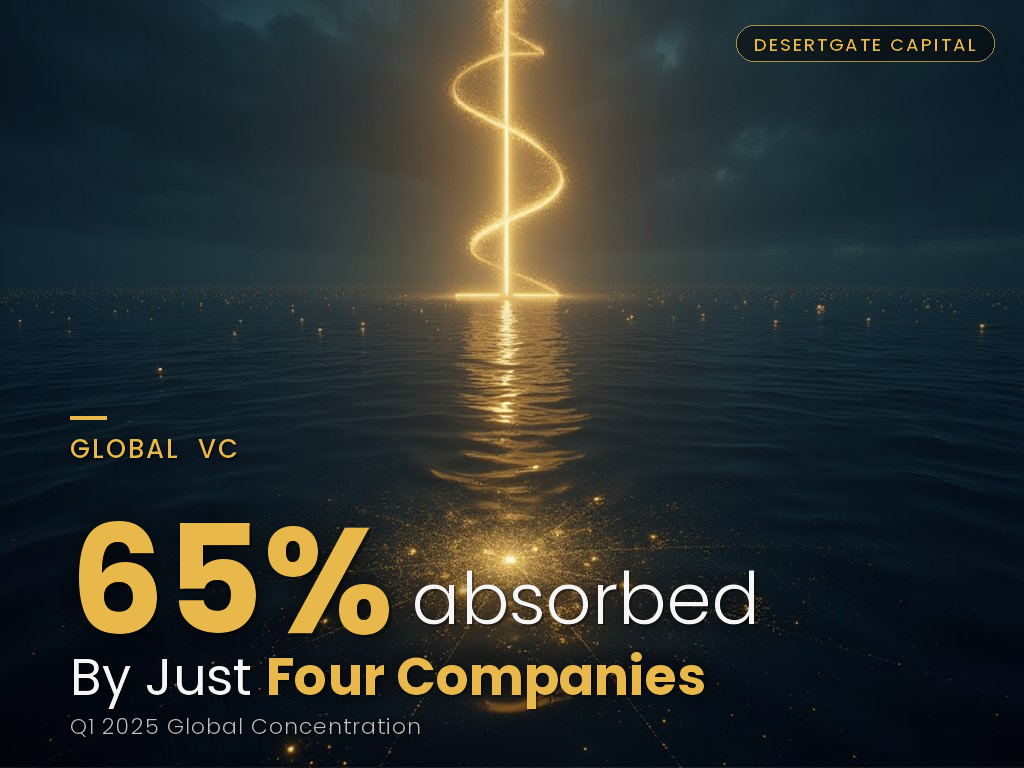
In Q1 2026, four companies absorbed 65% of all global venture capital. OpenAI alone closed a round that reached $122 billion. The number is so large it distorts the eye — but the real distortion is what it did to every other company trying to raise money in the same quarter.
Published: April 2026 · Desert Gate Capital Research Desk · Dubai, UAE
7-minute read · AI Investment · Early-Stage Strategy · Vertical AI
This is no longer a funding cycle. It is a gravitational event. Capital is being pulled toward foundational AI models with a force that leaves the rest of the venture landscape in a funding vacuum. For angel investors and seed-stage allocators, the question is no longer whether AI dominates — it is whether there is any oxygen left in the room, and if so, where exactly it sits. DesertGate Capital’s thesis: the best early-stage returns of this era will not come from competing with mega-rounds. They will come from the sectors those mega-rounds cannot reach.
The Data Reality
The numbers are unambiguous. In Q1 2026, AI startups captured $242 billion of the $300 billion deployed globally in venture capital — roughly 80% of all funding. Foundational AI alone accounted for $178 billion, with just three companies (OpenAI, Anthropic, and xAI) absorbing $172 billion of that figure, or 96.6% of all foundational AI capital.
Source: Crunchbase, Q1 2026 Venture Funding Report
The concentration is historically unprecedented. In 2025, AI startups captured $192.7 billion of $366.8 billion in total VC investment — the first year AI took more than half. By Q1 2026, that share had surged to 80%. Meanwhile, the total number of venture funds successfully raising capital globally plummeted from 4,430 in 2022 to just 823 in 2025 — an 81% decline.
Source: PitchBook, 2025 Annual VC Report
For non-AI startups, the picture is severe. Funding to non-AI companies declined year-over-year through 2025 and into 2026. Late-stage AI companies now command a 100% valuation premium over non-AI peers at Series C. As PitchBook’s director of research put it: “The market is becoming bifurcated. You’re in AI, or you’re not.”
| Metric | 2025 Full Year | Q1 2026 |
| AI Share of VC Funding | 52.5% ($192.7B) | 80% ($242B) |
| Foundational AI (Top 3) | — | $172B (96.6% of segment) |
| Active VC Funds Globally | 823 | Declining |
| AI vs Non-AI Valuation Gap (Series C) | ~50% premium | ~100% premium |
Sources: Crunchbase Q1 2026, PitchBook 2025 Annual Report, Qubit Capital 2026 AI Funding Analysis
The Thesis: Capital Gravity Creates Opportunity at the Edges
DesertGate Capital’s position is straightforward: the most asymmetric early-stage returns over the next three to five years will come not from foundational AI but from three categories that mega-capital structurally cannot serve.
1. Vertical AI Applications. Industry-specific AI tools in healthcare, legal, financial services, and industrial operations. These companies solve domain-specific problems that require proprietary data, regulatory expertise, and deep workflow integration — none of which can be commoditised by a foundation model API call. Vertical SaaS integrated with AI is growing at 28% year-over-year and outpacing horizontal software by a 3:1 ratio, according to Qubit Capital.
2. Edge AI Infrastructure. Companies deploying inference at the device level — in autonomous systems, robotics, defense, and industrial IoT — where cloud connectivity is unreliable, latency is unacceptable, or security requirements prohibit data leaving the device. The edge AI market hit $35.8 billion in 2025 and is projected to reach $385.9 billion by 2034, a tenfold expansion. Shield AI raised $440 million for autonomous drone technology that operates entirely without GPS or cloud connectivity. The defense and industrial edge is a capital-hungry frontier that foundational model companies are not built to serve.
3. AI-Native Fintech and RegTech. Financial services remain one of the most data-rich, regulation-heavy, and relationship-dependent industries on earth. AI tools that navigate compliance, automate underwriting, or restructure cross-border payments require domain depth that horizontal AI products lack. LegalTech funding alone hit $4.3 billion in 2025, up 54% from 2024.
What unites these three categories is a single structural advantage: defensibility. A foundation model can generate text, code, and images for anyone. It cannot navigate FDA approval pathways, operate a drone in a GPS-denied environment, or interpret DIFC regulatory frameworks. The moat is in the domain, not the model.
The Institutional Lens
Professional investors see something that most angel investors and first-time allocators miss: the headline AI numbers are not investable at early stage. When OpenAI raises $122 billion, that capital comes from sovereign wealth funds, large-cap crossover investors, and government-adjacent strategic players. Angel syndicates are structurally excluded.
The data confirms this. Of the 24 foundational AI deals in Q1 2026, just three companies absorbed 96.6% of the capital. The remaining 21 deals shared $6 billion — still large by historical standards, but with median round sizes that have pushed well past the $500 million mark. For an angel syndicate writing $500K to $5 million cheques, there is no entry point.
This is not a problem. It is a map. The capital vacuum created by mega-rounds is precisely where early-stage investors should be looking. When institutional capital floods foundational AI, it pulls GP attention, LP allocation, and media coverage with it. Vertical AI, edge AI, and AI-native fintech companies are raising in relative quiet — at valuations that reflect their sector, not the hype cycle of the companies beside them in the headlines.
Vertical AI delivered $132.7 billion in exits across 158 transactions in 2025, with healthcare leading at 43 exits. The IPO window opened with 18 vertical AI offerings after a two-year drought. This is a sector producing liquidity, not just funding rounds.
Source: Euclid Ventures, Vertical AI Report 2026
The DesertGate Capital Early-Stage AI Allocation Framework
For angels, syndicates, and seed-stage funds navigating this market, DesertGate Capital proposes a five-stage allocation framework.
Stage 1 — Filter by Defensibility
Before evaluating any AI startup, ask one question: can a foundation model API replicate this product in six months? If the answer is yes — or even maybe — move on. The investable opportunities are those where proprietary data, regulatory moats, hardware integration, or domain-specific workflows create barriers that model intelligence alone cannot breach.
Stage 2 — Map the Domain Depth
The best vertical AI companies are not “AI for X” rebrands. They are built by operators who understand the workflow before they understood the model. Prioritise founding teams with 5+ years in the target industry, not teams that picked a vertical after building a GPT wrapper.
Stage 3 — Size the Deployment Constraint
Edge AI and defense applications carry a deployment constraint that is itself a moat. If the product must operate in bandwidth-limited, latency-sensitive, or security-classified environments, the competitive field narrows dramatically. Size this constraint: the harder the deployment, the deeper the moat.
Stage 4 — Validate the Revenue Signal
In a market where seed valuations average $16 million pre-money and top-tier companies are raising at $20–25 million post-money, revenue validation is non-negotiable. For vertical AI at seed stage, look for $150K–$500K ARR, 2–3 enterprise contracts, and a clear line to $2 million ARR within 18 months. The burn multiple should be below 2.0x.
Source: Carta, State of Pre-Seed 2025; Flowjam, Seed Round Valuation Guide 2025
Stage 5 — Structure for Follow-On Optionality
Angel and seed capital in this environment must be structured with follow-on in mind. Use post-money SAFEs with valuation caps at or below $15 million for pre-seed and priced rounds at seed. Ensure pro-rata rights. The goal is to maintain ownership through Series A, which now takes a median of 616 days from seed — so plan for a longer hold than historical norms.
The Verdict
The $242 billion flowing into AI in a single quarter is not a rising tide. It is a tidal wave — and tidal waves do not lift all boats. They concentrate force in a narrow channel and leave everything outside that channel exposed.
For early-stage investors, the signal is clear. Do not stand in the channel. Stand where the water recedes and reveals what was always underneath: vertical depth, edge deployment, regulatory complexity, and domain expertise that no foundation model can replicate. That is where the next generation of outsized returns will be built — quietly, at reasonable valuations, by founders who chose defensibility over hype.
The angels who understand this will not be priced out. They will be priced in — to the opportunities that matter.
Desert Gate Capital
Registered in Dubai, UAE · desertgatecapital.com
This article is for informational purposes only and does not constitute investment advice. All data cited from third-party sources as referenced.