
How inflated early-stage valuations are building a generation of startups that cannot survive their own success
Published: April 2026 · Desert Gate Capital Research Desk · Dubai, UAE
8-minute read · AI Startups · Seed Valuations · Venture Capital
A founder walks into a seed round with a prototype, two enterprise LOIs, and zero revenue. She walks out with $10 million at a $40 million post-money valuation. Eighteen months ago, that round would have been a Series A. Today, it is Tuesday.
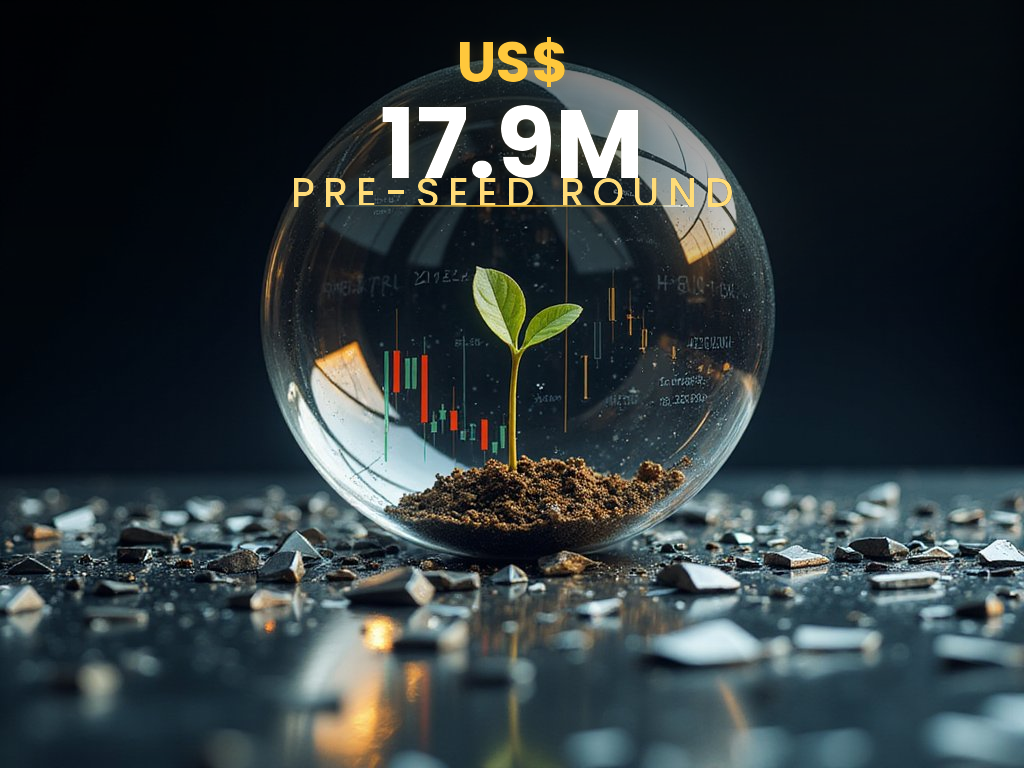
This is the new arithmetic of AI seed investing. The median pre-money valuation for AI seed-stage startups has reached $17.9 million—42% above their non-AI peers, according to Carta and Crunchbase data from Q1 2026. Seed rounds of $5 million to $10 million are routine. And $297 billion flowed into global startups in Q1 alone, a record that makes 2021’s peak look restrained. The question is no longer whether this repricing is real. It is whether founders understand what they are buying when they accept it.
The Data Reality
The numbers tell a story of two markets running at different speeds. On one track, AI companies are raising larger rounds, faster, at higher multiples. On the other, everything else is fighting for the scraps.
| Metric | AI Startups (2026) | Non-AI Startups (2026) |
| Median Seed Pre-Money Valuation | $17.9M | $12.6M |
| Median Seed Round Size | $5M–$10M | $2.5M–$4M |
| Typical Revenue Multiple | 10x–25x | 5x–10x |
| Median Post-Money (Seed) | $24M (all-time high) | $14M–$16M |
| Time to Series A | 14–18 months | 18–24 months |
Sources: Carta State of Seed Report (Q4 2025); Crunchbase Q1 2026 Venture Monitor; TechCrunch analysis (March 2026); Qubit Capital AI Funding Report.
Carta’s Q4 2025 data shows the median post-money seed valuation hit a new all-time high of $24 million. For AI companies specifically, it is now common to see $10 million seed rounds at $40–$45 million post-money valuations. Meanwhile, SAFEs account for 92% of all pre-priced rounds at the pre-seed stage, meaning most of these valuations are being set without the governance structures that priced rounds bring.
Q1 2026 saw $297 billion injected into startups globally, per Crunchbase. That figure is not distributed evenly. AI is capturing an outsized share of total venture deployment, pulling capital away from non-AI companies and concentrating it in a narrower set of bets. The result is a market where AI founders feel flush while non-AI founders feel starved—and where AI valuations are being set by competitive dynamics between investors, not by fundamentals.
The Valuation Trap: Five Ways Inflated Seed Rounds Punish Founders
A high seed valuation feels like validation. It is often a liability. Here is what happens when a company prices its seed round at 2x or 3x the market median:
- The Series A bar becomes punishing. Series A investors in 2026 expect $2–$5 million ARR, net revenue retention above 110%, and gross margins above 70%. If you raised seed at a $40 million post-money, you need to justify a $100–$120 million Series A valuation to avoid a down round. That requires tripling or quadrupling revenue in 14–18 months—a bar that most AI companies, still burning through inference costs and iterating on product-market fit, cannot clear.
- Bridge rounds become death sentences. When the Series A does not materialise, founders turn to bridge financing. But a bridge round priced off a $40 million post-money creates cap table toxicity: existing investors face dilution into a company that has not proven it can grow into its valuation. Of the 14,000 AI startups launched globally in 2024, 40% have already shut down, according to industry tracking. Many of those failures began with a seed round they could not outgrow.
- Unit economics get buried under hype. AI startups face a structural cost problem that software companies do not: inference costs, compute infrastructure, and data pipeline expenses erode gross margins. Many AI applications run on negative gross margins in their first 12–18 months. Investors pricing seed rounds at 10–25x revenue are betting on future margin expansion that may never arrive.
- Governance disappears at the worst moment. With 92% of pre-seed rounds done on SAFEs, most AI startups reach seed stage with no board, no priced equity, and no formal governance. The seed round itself is increasingly done on SAFEs at higher amounts. This means companies burning $200–$500K per month have no independent oversight until—sometimes—Series A. By then, the runway decisions have already been made.
- Founder ownership erodes faster than expected. A $10 million seed round on a $40 million post-money gives away 25%. Add the pre-seed SAFE conversion, option pool expansion, and a potential bridge, and founders can enter Series A owning 40–45% of a company whose valuation they must now justify at 3x the seed price. The math compresses quickly.
The Institutional Lens: What Fund Managers See That Founders Miss
Professional investors deploying from fund structures operate under constraints that founders rarely consider. Understanding these constraints explains why the current seed market is more fragile than it appears.
Fund return math dictates selectivity. A seed fund writing $2–3 million cheques from a $50 million vehicle needs its winners to return 30–50x to generate top-quartile fund performance. When seed valuations inflate from $12 million pre-money to $18–20 million, the return multiple required at exit increases proportionally. The same exit that returned 40x at a $10 million entry now returns 20x at $20 million. Fund managers see this compression before founders do.
Portfolio construction is shifting. At DesertGate Capital’s research desk, we track how institutional seed investors are responding. The pattern is clear: cheque sizes are rising, but portfolio breadth is narrowing. Funds are writing fewer, larger bets and demanding more proof points before deploying. The era of spraying fifty $500K cheques and hoping for outliers is ending. What has replaced it is conviction-based deployment—but conviction anchored in metrics, not narratives.
The secondaries signal is loud. One of the clearest indicators of valuation stress is the growth of secondary markets. When early investors sell seed positions at discounts to face value, it signals that the insiders who priced those rounds do not believe the markups will hold. Secondary transaction volume for venture-backed positions has increased substantially, with some early-stage AI positions trading at 20–40% discounts to their last round price.
The Seed Stress Test: A Six-Stage Framework for AI Founders
Before accepting any seed term sheet, run your company through this framework. Each stage reveals whether your valuation is earned or borrowed.
- Baseline Audit — Calculate your current monthly burn, gross margin on delivered product (not projections), and months of runway. If your gross margin is below 50% and your runway is under 18 months post-close, the valuation is almost certainly too high for your stage.
- Series A Reverse Engineering — Take your proposed post-money valuation and multiply by 2.5–3x. That is the minimum Series A pre-money you will need to avoid a down round. Now calculate the ARR required to justify that figure at a 15–20x revenue multiple. If the number exceeds $4 million, you have 14–18 months to get there. Model whether your current growth rate makes that achievable.
- Bear Case Modelling — Build a financial model at 50% of plan. Does the company survive? Does it reach a meaningful milestone (not just survival, but enough traction to raise again)? If your bear case requires another fundraise within 8 months, you are undercapitalised at any valuation.
- Governance Check — If raising on a SAFE, negotiate a conversion trigger that creates a board within 12 months. If raising a priced round, ensure at least one independent or investor board seat. The governance vacuum that SAFEs create is manageable at $1–2 million but dangerous at $5–10 million.
- Compute Cost Stress Test — Project your inference and training costs at 3x current usage. AI compute costs do not scale linearly with revenue—they often scale faster. Model the scenario where your largest customer doubles usage. Can you serve them profitably?
- Ownership Waterfall — Map your cap table through to Series A. Include SAFE conversions, option pool expansion (assume 10–15% refresh), and a realistic Series A dilution of 20–25%. If founders exit this model below 35% ownership, the valuation premium at seed came at the cost of long-term alignment.
The Verdict
The AI seed market in 2026 is not a bubble in the simplistic sense—there is real technology, real enterprise demand, and real revenue being generated. What it is, more precisely, is a mispricing of time. Investors are paying Series A prices for seed-stage risk, and founders are accepting those prices without modelling the Series A consequences.
Forty percent of AI startups launched in 2024 have already failed. The next wave of casualties will not be companies that could not build products. They will be companies that could not grow into the valuations they accepted when capital was cheap and conviction was expensive.
The founders who survive this cycle will be the ones who treated a high seed valuation not as a trophy, but as a debt—one that compounds with every month of missed targets. Price your round for the company you are. Build for the company you need to become. The market will not wait.
Desert Gate Capital
Registered in Dubai, UAE · desertgatecapital.com
“This article is for informational purposes only and does not constitute investment advice. All data cited from third-party sources as referenced.“